How to Stop Overthinking: 10 Practical Ways to Calm Your Mind
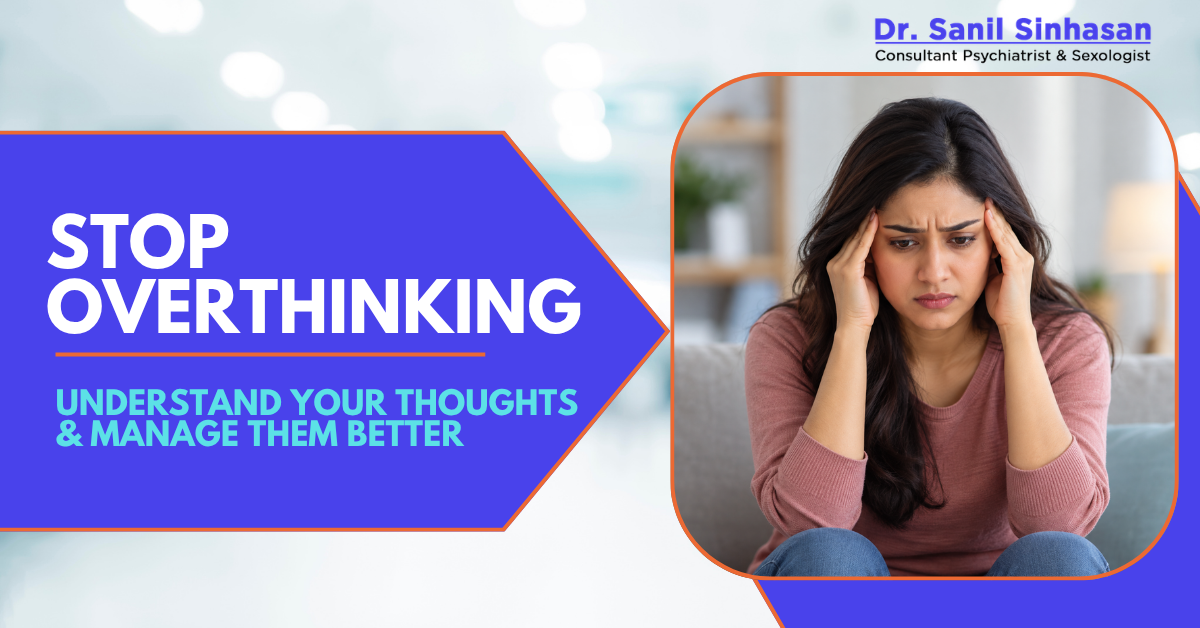
Have you ever replayed the same conversation again and again? Do you spend hours worrying about what might happen tomorrow? Or do small decisions become exhausting because your mind keeps analysing every possible outcome?
This pattern is commonly described as overthinking.
Occasional thinking and worrying are normal. But when thoughts become repetitive, difficult to control and emotionally exhausting, they can affect your sleep, concentration, relationships, work and overall mental well-being.
Overthinking may also occur alongside anxiety, depression, chronic stress and other mental health concerns.
The good news is that you can learn healthier ways to respond to repetitive thoughts. Simple strategies such as identifying thought patterns, setting aside “worry time,” practising grounding and challenging unhelpful thoughts can help.
What Is Overthinking?
Overthinking means repeatedly analysing a situation, problem, decision or emotion without reaching a useful solution or taking meaningful action.
It may involve:
- Replaying past conversations
- Thinking repeatedly about mistakes
- Worrying about future situations
- Imagining worst-case scenarios
- Constantly questioning your decisions
- Seeking repeated reassurance
- Analysing what other people might think about you
- Finding it difficult to mentally “switch off”
In psychology, some patterns commonly described as overthinking may overlap with rumination and worry.
Rumination tends to involve repeatedly dwelling on distressing thoughts, feelings or past experiences. Worry is often more focused on uncertainty and possible future threats.
Overthinking itself is not necessarily a psychiatric diagnosis. However, persistent repetitive negative thinking can be associated with conditions such as anxiety and depression.
Why Do I Overthink Everything?
There is rarely one single reason.
Your mind naturally tries to predict problems and protect you from uncertainty. Sometimes, however, this problem-solving process becomes repetitive rather than productive.
Common factors that may contribute to excessive overthinking include:
- Anxiety
- Chronic stress and burnout
- Fear of making mistakes
- Perfectionism
- Low self-confidence
- Difficult past experiences
- Relationship difficulties
- Work pressure
- Major life changes
- Poor sleep and insomnia
- Depression
- Difficulty tolerating uncertainty
Example: How a thought spirals
After an important meeting, you may think:
“Did I say something wrong?”
Your mind may then move to:
“Maybe everyone noticed.”
Then:
“What if they think I am incompetent?”
Before long, one small concern has turned into a long chain of negative possibilities.
Recognising this pattern is an important first step towards changing it.
How to Stop Overthinking: 10 Practical Strategies
You may not be able to prevent every unwanted thought from appearing. The goal is to change how much attention you give those thoughts and how you respond to them.
Here are 10 strategies that may help:
1. Notice When You Are Overthinking
You cannot change a pattern that you do not recognise. Start paying attention to moments when your thinking becomes repetitive.
Ask yourself:
“Am I solving this problem, or am I thinking about the same thing repeatedly?”
Productive thinking usually leads towards a decision or action. Overthinking often leads back to the same questions without producing a solution. Simply noticing this difference can help you interrupt the cycle.
2. Write Your Thoughts Down
When several thoughts are moving through your mind at once, they can feel overwhelming. Writing them down may make them easier to examine.
Try writing:
- What am I worried about?
- What evidence supports this thought?
- What evidence does not support it?
- Is there something I can do about it today?
- What would I tell a friend who had the same worry?
This approach is similar to techniques used in Cognitive Behavioural Therapy (CBT) to identify and reframe unhelpful thinking patterns.

3. Separate Facts From Assumptions
Overthinking frequently involves treating possibilities as if they are facts.
Suppose someone does not reply to your message. Your mind may immediately think:
“They are angry with me.”
But the fact is simply:
“They haven't replied yet.”
There could be many explanations.
Whenever your mind jumps to a negative conclusion, ask:
“What do I actually know, and what am I assuming?”
Creating this distinction can reduce unnecessary mental escalation.
4. Set a Specific “Worry Time”
Trying to force yourself to stop worrying completely can be difficult. Instead, schedule a short period of the day to think about your worries.
For example, you might set aside 10–15 minutes.
When a worry appears outside that period, make a quick note and tell yourself that you will return to it during your scheduled worry time.
During that period, review your concerns and identify which ones require action. This can help prevent worries from occupying your entire day.
5. Focus on What You Can Control
Overthinking often focuses on situations outside your control.
Instead of repeatedly asking:
“What if something goes wrong?”
Try asking:
“What can I do about this right now?”
If you are worried about an interview, you can prepare. If you are worried about an unresolved conversation, you can decide whether to communicate.
If there is no useful action available, repeatedly analysing the situation may not provide additional control. Directing attention towards practical action can make thinking more productive.
6. Practise Slow Breathing and Grounding
When anxiety increases, your thoughts may speed up too. Grounding techniques can redirect attention from repetitive thoughts towards what is happening around you right now.
One simple method is the 5-4-3-2-1 technique — notice:
- 5 things you can see
- 4 things you can touch or feel
- 3 things you can hear
- 2 things you can smell
- 1 thing you can taste or notice
You can also practise slow, comfortable breathing. Focus your attention on each breath rather than trying to fight your thoughts. The purpose is not to “empty” your mind. It is to bring your attention back to the present moment.
7. Take Action Instead of Waiting for Certainty
Overthinking and indecision often reinforce each other.
You may think:“What if I make the wrong decision?”
So you analyse every possibility. The more you analyse, the less certain you feel.
For everyday decisions, accept that complete certainty may not be possible.
Ask:
“Do I have enough information to make a reasonable decision?”
If the answer is yes, choose the next practical step. You can adjust later if necessary.
8. Reduce Mental Stimulation Before Bed
Many people notice that overthinking becomes stronger at night. There are fewer distractions. The environment becomes quiet. Unresolved worries may suddenly demand attention.
A regular bedtime routine can help. Consider:
- Reducing unnecessary screen time before sleeping
- Avoiding work immediately before bed
- Writing tomorrow's tasks down
- Keeping regular sleep and wake times
- Practising relaxation or slow breathing
- Avoiding repeated checking of messages or emails
If persistent thoughts are regularly preventing you from sleeping, both the sleep difficulty and its underlying cause deserve attention.
9. Move Your Body
Physical activity can provide a useful shift in attention when you are stuck in repetitive thinking. It does not necessarily mean an intense workout. You could:
- Take a walk
- Stretch
- Exercise
- Practise yoga
- Do household tasks
- Spend some time outdoors
The aim is not to use activity to avoid every difficult emotion. Instead, it can help break prolonged periods of sitting and thinking without action.
10. Talk to a Mental Health Professional When Overthinking Becomes Difficult to Manage
Self-help strategies can be useful, but persistent overthinking may sometimes be part of a broader mental health concern.
Consider consulting a mental health professional when repetitive thoughts:
- Occupy a large part of your day
- Regularly interfere with sleep
- Affect your work or studies
- Cause significant anxiety
- Make decision-making extremely difficult
- Affect your relationships
- Lead to frequent reassurance seeking
- Occur alongside persistent sadness or loss of interest
- Trigger panic symptoms
- Become difficult to control despite your efforts
A psychiatrist can assess whether the repetitive thinking is related to anxiety, depression, obsessive-compulsive symptoms, sleep difficulties or another condition. Treatment can then focus on the underlying problem rather than only the symptom of overthinking.
Can Overthinking Be a Sign of Anxiety?
Yes, persistent overthinking can occur with anxiety, although overthinking does not automatically mean that you have an anxiety disorder.
Anxiety may involve excessive worry, difficulty controlling worries, restlessness, irritability, difficulty concentrating, muscle tension or disturbed sleep.
When these symptoms are persistent or interfere with everyday functioning, a professional assessment can help determine what is happening.
Can Overthinking Cause Anxiety?
Overthinking and anxiety can reinforce each other.
A person may initially worry about a problem. Repeatedly analysing possible negative outcomes can increase distress. Increased anxiety can then generate even more worrying thoughts.
Breaking the cycle may involve learning to recognise repetitive thoughts, redirect attention, tolerate uncertainty and respond differently to worries.
Does Overthinking Affect Sleep?
Yes. Repetitive thinking can make it difficult to relax mentally at bedtime. You may find yourself thinking about:
- Tomorrow's responsibilities
- Work problems
- Financial concerns
- Relationship issues
- Past mistakes
- Health concerns
- Conversations from earlier in the day
Persistent stress and worry can be associated with sleep difficulties.
If overthinking and insomnia repeatedly occur together, addressing both may be important.
Can CBT Help With Overthinking?
Cognitive Behavioural Therapy (CBT) may help people recognise and change unhelpful patterns of thinking and behaviour.
CBT-based approaches may involve learning to:
- Identify automatic negative thoughts
- Examine thoughts more objectively
- Challenge unhelpful assumptions
- Reduce avoidance
- Improve problem-solving
- Develop healthier responses to worry
- Manage anxiety-provoking situations
Research on repetitive negative thinking has found benefits from CBT-based interventions, particularly approaches that directly target rumination and worry. The appropriate treatment depends on the person's symptoms and underlying condition.
When Should You Consult a Psychiatrist for Overthinking?
Consider seeking professional help when overthinking is no longer an occasional inconvenience and starts interfering with your everyday life.
You may benefit from an assessment if you experience persistent:
- Anxiety
- Excessive worry
- Panic attacks
- Sleep problems
- Low mood or depression
- Irritability
- Poor concentration
- Obsessive thoughts
- Difficulty functioning at work
- Relationship problems
Seeking help does not mean that every person who overthinks needs medication.
A psychiatrist first evaluates your symptoms, their severity, duration and impact on your daily life. Depending on the underlying condition, management may include psychological strategies, counselling or psychotherapy, lifestyle changes and, when clinically appropriate, medication.
Looking for Help With Overthinking or Anxiety in Mumbai?
If repetitive thoughts, anxiety or stress are affecting your sleep, relationships, work or quality of life, a mental health assessment can help identify what may be contributing to them.
Dr. Sanil Sinhasan, MBBS, MD Psychiatry, is a Consultant Psychiatrist & Sexologist in Mumbai with more than 10 years of experience in the management of mental and sexual health concerns.
His areas of care include anxiety disorders, depression, stress management, insomnia, sexual disorders, counselling and other mental health concerns.
Take the First Step Towards a Calmer Mind
You do not have to spend every day trapped in the same cycle of thoughts. If overthinking has become persistent or difficult to manage, consider discussing your symptoms with a qualified mental health professional.
Book a consultation with Dr. Sanil Sinhasan, Psychiatrist in Mumbai, for an individual assessment and appropriate treatment guidance.
Call: +91 93247 30370
Consultation locations: Chembur, Tilaknagar and Dadar, Mumbai.
Book AppointmentFrequently Asked Questions
1. How can I stop overthinking immediately?
There is no technique that guarantees thoughts will stop immediately. You can, however, interrupt an overthinking cycle by recognising the thought, slowing your breathing, grounding yourself in your surroundings and shifting attention towards a practical action.
2. Why does my brain keep overthinking?
Repetitive thinking can be related to stress, uncertainty, anxiety, perfectionism, difficult experiences or a habit of repeatedly analysing problems. Persistent overthinking can also occur alongside certain mental health conditions.
3. How do I stop overthinking at night?
Write down unresolved tasks or worries before bed, reduce unnecessary stimulation, follow a regular sleep routine and practise relaxation or grounding. If worrying regularly prevents you from sleeping, consider discussing it with a mental health professional.
4. Is overthinking a mental illness?
Overthinking itself is not necessarily a mental illness. However, repetitive negative thinking can occur with anxiety, depression and other mental health conditions. A professional assessment may be useful when symptoms are persistent or interfere with daily functioning.
5. Can anxiety make you overthink everything?
Yes. Anxiety can make people repeatedly focus on uncertainty, possible threats and worst-case outcomes. However, frequent overthinking alone does not establish an anxiety disorder.
6. Can overthinking be treated?
Yes. The underlying causes and patterns associated with persistent overthinking can often be managed. Treatment may include psychological strategies such as CBT, stress-management techniques, lifestyle changes and treatment of an underlying mental health condition when present.
7. Should I see a psychiatrist for overthinking?
Consider seeing a psychiatrist or another qualified mental health professional when repetitive thoughts are difficult to control or are affecting your sleep, work, studies, relationships or emotional well-being.

 WhatsApp