Social Anxiety: Symptoms, Causes and How to Overcome It
You are invited to a gathering, but instead of feeling excited, you begin worrying about what people might think of you.
Before an office presentation, your heart starts racing. You rehearse every sentence, imagine making mistakes and wonder whether others will judge you.
Even a simple conversation with someone unfamiliar can feel uncomfortable.
You may tell yourself, "I am just shy."
But when fear of embarrassment or negative judgement repeatedly affects your confidence, relationships, work or everyday activities, it may be more than ordinary shyness.
Social anxiety disorder, also called social phobia, is a mental health condition involving persistent fear or anxiety about social situations in which a person may be observed, evaluated or judged by others.
The good news is that social anxiety can be treated. Psychological therapies, particularly Cognitive Behavioural Therapy (CBT), and certain medications can help people manage symptoms and participate more comfortably in everyday life.
Understanding the symptoms, possible causes and treatment options is an important first step.
What Is Social Anxiety Disorder?
Social anxiety disorder is a mental health condition characterised by an intense fear of social situations where a person believes they may be embarrassed, rejected, criticised or negatively judged.
The fear may occur during situations such as:
- Meeting unfamiliar people
- Speaking in public
- Participating in group discussions
- Attending social gatherings
- Eating or drinking in front of others
- Talking to someone in authority
- Making phone calls
- Being observed while performing a task
- Starting conversations
- Speaking during office meetings
Someone with social anxiety may recognise that their fear is excessive but still find it difficult to manage.
They may avoid social situations altogether or endure them with significant distress.
Unlike temporary nervousness, social anxiety disorder can persist over time and interfere with everyday functioning.
What Are the Symptoms of Social Anxiety?
Social anxiety can affect thoughts, emotions, physical sensations and behaviour.
Symptoms vary between individuals.
1. Intense Fear of Being Judged
You may constantly worry about what other people think of you.
For example:
"What if everyone notices that I am nervous?"
"What if they think I am not intelligent?"
These thoughts may appear before, during or after social interactions.
2. Excessive Worry Before Social Events
You may begin worrying several days before a meeting, presentation, interview or gathering.
You might repeatedly imagine negative outcomes and rehearse conversations in your mind.
This is sometimes called anticipatory anxiety.
3. Avoiding Social Situations
Avoidance is a common feature of social anxiety.
You may:
- Decline invitations
- Avoid meeting new people
- Remain silent during discussions
- Avoid speaking in meetings
- Choose not to attend interviews
- Avoid eating in public
- Ask others to make phone calls for you
Avoidance may reduce anxiety temporarily, but it can maintain fear over time.
4. Physical Symptoms During Social Interactions
Social anxiety can produce noticeable physical symptoms, including:
- Rapid heartbeat
- Sweating
- Trembling
- Blushing
- Nausea
- Muscle tension
- Shaky voice
- Difficulty speaking
- Feeling lightheaded
- Stomach discomfort
Some people become particularly anxious about others noticing these symptoms.
5. Difficulty Making Eye Contact
You may find eye contact uncomfortable because it increases the feeling of being observed or evaluated.
However, difficulty with eye contact alone does not indicate social anxiety disorder.
It can occur for many reasons, including individual communication styles and cultural differences.
6. Overthinking Conversations Afterwards
After a conversation, you may repeatedly review what happened.
You might think:
"Did I sound foolish?"
"Did they think I was awkward?"
This repeated review can reinforce negative beliefs about social interactions.
7. Fear of Speaking in Public
Presentations, interviews and meetings may cause significant anxiety.
You may worry about:
- Forgetting what to say
- Making mistakes
- Being criticised
- Blushing
- Trembling
- Losing your train of thought
Some people experience anxiety mainly in performance situations, while others fear a wider range of social interactions.
8. Low Confidence in Social Situations
You may feel capable and comfortable when alone but become unusually self-conscious around other people.
You might underestimate your social abilities or assume others are judging you negatively.
9. Difficulty Starting or Maintaining Conversations
Social anxiety can make ordinary conversations feel stressful.
You may struggle to introduce yourself, ask questions or participate naturally because you are focused on avoiding mistakes.
10. Social Anxiety Affecting Everyday Life
The most important concern is not simply feeling nervous.
It is whether the fear significantly affects your life.
Social anxiety may interfere with:
- Career opportunities
- Academic participation
- Friendships
- Relationships
- Everyday communication
- Social activities
- Quality of life
When symptoms become persistent and disruptive, professional assessment may be helpful.
Social Anxiety vs Shyness: What's the Difference?
Shyness and social anxiety are not the same.
Shyness is a personality characteristic or common emotional response. Social anxiety disorder is a recognised mental health condition.
| Shyness | Social Anxiety Disorder |
|---|---|
| May involve mild discomfort around unfamiliar people | Involves marked fear or anxiety about negative evaluation |
| Often becomes easier as familiarity increases | Fear may remain intense even in familiar situations |
| Does not necessarily interfere with everyday life | Can significantly affect work, studies, relationships or social activities |
| May not lead to avoidance | Often involves avoidance or enduring situations with intense distress |
| Does not automatically require treatment | May benefit from professional assessment and treatment |
A shy person does not necessarily have social anxiety disorder.
Similarly, someone who appears confident in certain situations may still experience significant social anxiety in others.
What Causes Social Anxiety Disorder?
Social anxiety disorder does not have one single cause.
Research suggests that genetic, biological, psychological and environmental factors may contribute.
1. Family History and Genetic Factors
Anxiety disorders can occur more frequently in some families.
However, having a family member with anxiety does not mean someone will necessarily develop social anxiety disorder.
2. Temperament and Behavioural Inhibition
Some individuals are naturally more cautious or sensitive in unfamiliar situations.
A temperament characterised by behavioural inhibition may be associated with a greater likelihood of developing anxiety problems.
3. Difficult Social Experiences
Experiences such as bullying, repeated criticism, humiliation or rejection may contribute to fear of negative judgement in some individuals.
However, social anxiety does not always result from a specific negative experience.
4. Learned Patterns of Thinking
People with social anxiety may develop patterns such as:
- Expecting rejection
- Overestimating the likelihood of embarrassment
- Assuming others are evaluating them negatively
- Focusing excessively on perceived mistakes
- Underestimating their ability to cope
These patterns can reinforce anxiety.
5. Stressful Life Transitions
Starting college, changing jobs, moving to a new city or taking on public-facing responsibilities may increase social anxiety symptoms in some people.
6. Other Mental Health Conditions
Social anxiety may occur alongside depression, other anxiety disorders or substance-use problems.
A clinical assessment can help identify overlapping conditions and guide treatment.
What Situations Commonly Trigger Social Anxiety?
Social anxiety triggers differ between individuals.
Common examples include:
| Situation | Common Worry |
|---|---|
| Office presentation | "What if I make a mistake?" |
| Job interview | "What if they think I am not capable?" |
| Meeting new people | "What if I have nothing interesting to say?" |
| Eating in public | "What if people watch me?" |
| Group discussion | "What if my opinion sounds foolish?" |
| Phone call | "What if I say something wrong?" |
| Social gathering | "What if nobody wants to talk to me?" |
| Speaking to a senior colleague | "What if I embarrass myself?" |
The fear is often linked to the possibility of negative evaluation rather than the situation itself.
Can Social Anxiety Cause Panic Attacks?
Yes. Some people with social anxiety experience panic attacks during feared social situations.
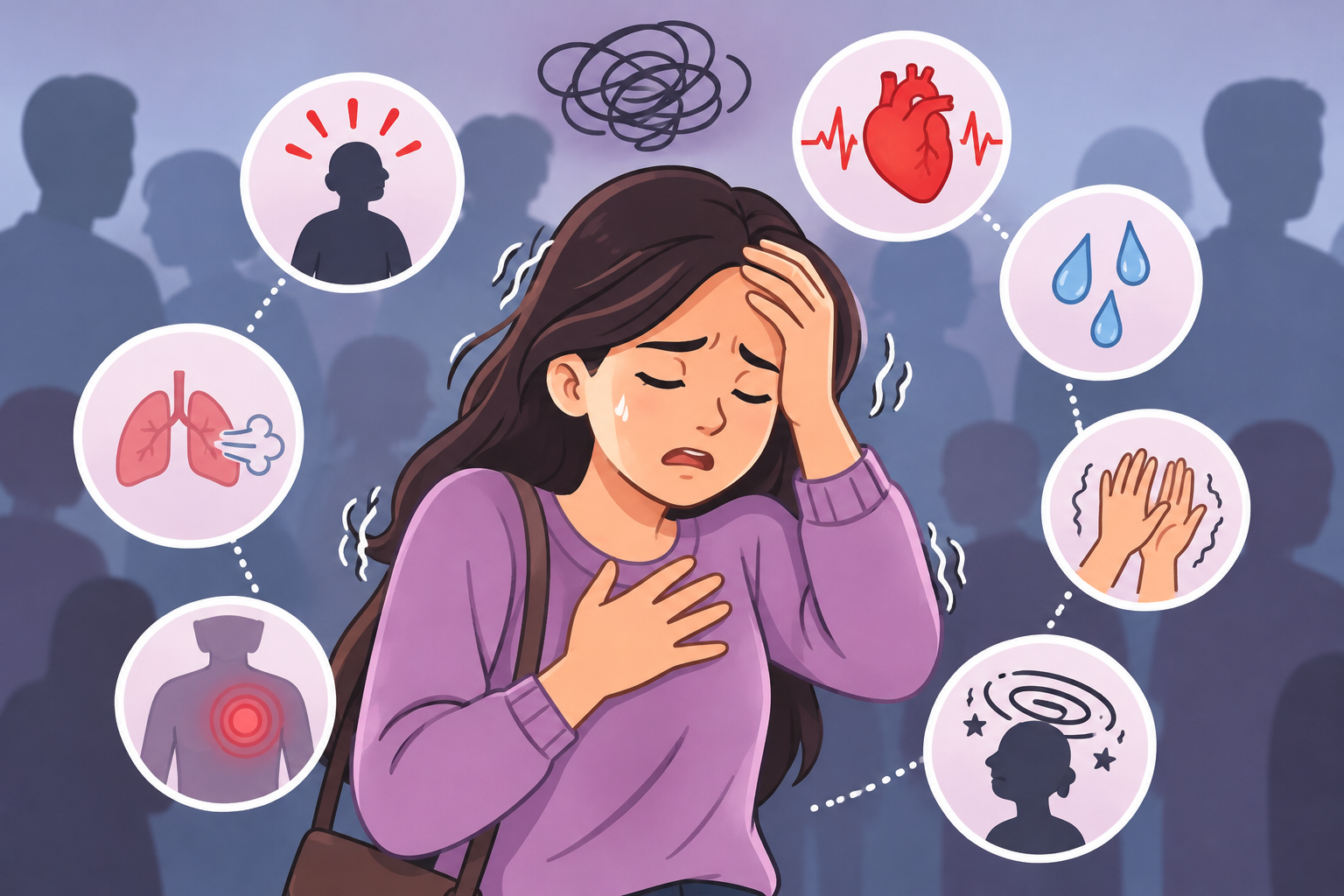
A panic attack may involve:
- Sudden intense fear
- Racing heartbeat
- Sweating
- Trembling
- Shortness of breath
- Dizziness
- Chest discomfort
- Fear of losing control
However, social anxiety disorder and panic disorder are different conditions.
In social anxiety, panic symptoms are often associated with situations involving possible scrutiny or judgement.
In panic disorder, recurrent panic attacks may occur unexpectedly, with ongoing concern or behavioural changes related to future attacks.
Important: New or severe chest pain, fainting or significant breathing difficulty requires appropriate medical evaluation rather than automatically assuming the cause is anxiety.
How Is Social Anxiety Diagnosed?
Social anxiety disorder is diagnosed through a clinical assessment.
A psychiatrist or another appropriately qualified mental health professional may ask about:
- The situations that trigger fear
- The thoughts associated with social interactions
- Physical symptoms
- Avoidance behaviours
- How long symptoms have been present
- Their impact on work, studies and relationships
- Other mental health symptoms
- Medical conditions
- Medication or substance use
For a diagnosis of social anxiety disorder, symptoms generally involve persistent fear or anxiety about social situations, avoidance or significant distress, and meaningful impairment.
Diagnostic criteria typically require the fear to persist for at least six months, although people can seek help well before that.
A diagnosis should not be based only on an online questionnaire.
How to Overcome Social Anxiety
Social anxiety can improve with appropriate support and consistent practice.
The following strategies may help people manage symptoms, particularly when combined with evidence-based treatment where needed.
1. Recognise Your Fear Patterns
Notice the situations that trigger anxiety.
Ask yourself:
"Am I assuming that others are judging me?"
"What evidence supports that assumption?"
Understanding the pattern can help you respond more thoughtfully.
2. Challenge Unhelpful Thoughts
Social anxiety often involves predicting negative outcomes.
For example:
A more balanced response might be:
"I may make a mistake, but that does not mean everyone will judge me negatively."
The goal is not to force positive thinking.
It is to evaluate anxious predictions more realistically.
3. Gradually Face Feared Social Situations
Avoidance can provide short-term relief but may maintain anxiety.
Gradual exposure involves approaching feared situations in manageable steps.
For example:
- Say hello to a colleague.
- Ask a simple question.
- Participate briefly in a group conversation.
- Share an opinion during a meeting.
- Practise a short presentation.
These are illustrative steps, not a fixed treatment plan.
A therapist can help create an individualised exposure plan, particularly when anxiety is severe.
4. Reduce Excessive Self-Monitoring
During conversations, you may focus heavily on:
- How your voice sounds
- Whether you are blushing
- Your facial expressions
- Your body language
- Whether you appear nervous
This intense self-monitoring can increase anxiety.
Practising attention towards the conversation rather than constantly evaluating yourself may help.
5. Avoid Repeatedly Replaying Conversations
After social interactions, try to notice when reflection becomes repetitive self-criticism.
Instead of analysing every sentence, consider whether there is a specific useful lesson.
If not, gently redirect your attention to another activity.
6. Practise Communication Skills
Some people benefit from practising:
- Introducing themselves
- Asking open-ended questions
- Expressing opinions
- Setting boundaries
- Participating in conversations
Communication practice can build confidence, but social anxiety is not simply a lack of social skills.
7. Use Relaxation Strategies
Slow breathing, grounding exercises and mindfulness may help manage physical tension.
These techniques can support coping, although they do not replace evidence-based treatment for significant social anxiety.
8. Maintain Healthy Daily Habits
Regular sleep, physical activity and limiting excessive caffeine may support mental well-being.
Alcohol should not be relied upon to make social interactions easier.
9. Set Realistic Social Goals
You do not need to become the most outgoing person in every room.
Progress may mean:
- Speaking once during a meeting
- Attending a gathering for a manageable period
- Starting a conversation
- Asking a question
- Participating despite some nervousness
The goal is to reduce fear-driven restrictions on your life, not to change your personality.
10. Seek Professional Help When Anxiety Persists
If social anxiety significantly affects your work, studies, relationships or daily activities, professional treatment can help.
What Is the Most Effective Treatment for Social Anxiety?
Individual Cognitive Behavioural Therapy (CBT) specifically designed for social anxiety disorder is a recommended first-line treatment for many adults.
Treatment may also include medication when clinically appropriate.
The choice depends on symptom severity, individual preference, previous treatment and other health considerations.
How Does CBT Help With Social Anxiety?
CBT helps people understand and change the patterns of thinking and behaviour that maintain anxiety.
Treatment may focus on:
- Fear of negative evaluation
- Excessive self-focused attention
- Avoidance
- Safety behaviours
- Negative predictions
- Repetitive analysis after social situations
CBT for social anxiety often includes behavioural experiments and gradual exposure to feared social situations.
For example, someone who fears speaking in meetings may practise participating without repeatedly rehearsing every sentence or seeking reassurance afterwards.
The purpose is to develop greater confidence in managing uncertainty and social discomfort.
Is Medication Used for Social Anxiety?
Medication may be considered for some people with social anxiety disorder.
Certain antidepressants, particularly Selective Serotonin Reuptake Inhibitors (SSRIs), are used in treatment.
A psychiatrist may consider medication based on:
- Symptom severity
- Functional impairment
- Patient preference
- Other mental health conditions
- Previous treatment response
- Potential side effects
- Medical history
Medication is not necessary for every person experiencing social anxiety.
Do not start, stop or change psychiatric medication without consulting your prescribing clinician.
Can Social Anxiety Be Treated Without Medication?
Yes.
CBT specifically developed for social anxiety disorder is an established psychological treatment.
Some people improve with therapy without requiring medication.
Others may benefit from medication or a combination of approaches.
The most appropriate treatment depends on individual assessment.
Can Social Anxiety Go Away on Its Own?
Some people experience reduced anxiety as they become more familiar with particular situations.
However, social anxiety disorder can persist without treatment.
Avoidance may also make feared situations increasingly difficult over time.
Evidence-based treatment can help reduce symptoms and improve everyday functioning.
Recovery does not necessarily mean never feeling nervous again.
It means being better able to participate in social situations without excessive fear or avoidance controlling your decisions.
How Long Does Social Anxiety Treatment Take?
There is no fixed recovery timeline.
Treatment duration depends on:
- Symptom severity
- How long anxiety has been present
- The situations involved
- Avoidance patterns
- Other mental health conditions
- Treatment approach
- Consistency with therapy
Improvement is often gradual.
Someone may initially feel anxious during conversations but gradually become more comfortable participating.
The goal is meaningful improvement rather than expecting anxiety to disappear overnight.
Social Anxiety at Work: Why It Can Affect Your Career
Social anxiety can influence professional life.
For example, someone may have strong technical knowledge but avoid:
- Presentations
- Team discussions
- Networking
- Interviews
- Speaking with senior colleagues
- Taking leadership responsibilities
They may be incorrectly perceived as uninterested or lacking confidence.
In reality, fear of negative judgement may be limiting their participation.
Addressing social anxiety can help people pursue opportunities that they previously avoided.
Social Anxiety in College Students and Young Adults
Social anxiety often begins during childhood or adolescence, although people may seek help much later.
College students and young adults may experience difficulties with:
- Making friends
- Classroom participation
- Presentations
- Interviews
- Group activities
- Dating
- Social gatherings
When anxiety causes persistent distress or avoidance, early assessment can help identify appropriate support.
When Should You See a Psychiatrist for Social Anxiety?
Consider professional assessment if:
- You frequently avoid social situations because of fear
- You worry excessively about being judged
- Social interactions cause significant physical anxiety
- You repeatedly overanalyse conversations
- Anxiety affects your studies or work
- You avoid interviews, presentations or meetings
- Your relationships are affected
- You rely on alcohol to cope socially
- Symptoms persist or worsen
- Self-help strategies are not enough
You do not need to wait until anxiety becomes severe before seeking support.
Looking for Social Anxiety Treatment in Mumbai?
If fear of judgement, public speaking, social interactions or embarrassment is interfering with your everyday life, a professional assessment may help.
Dr. Sanil Sinhasan, MBBS, MD Psychiatry, is a Consultant Psychiatrist & Sexologist in Mumbai with more than 10 years of experience in managing mental and sexual health concerns.
A psychiatric consultation can help assess symptoms, identify possible anxiety disorders and discuss appropriate treatment options.
Treatment recommendations should be based on individual symptoms, medical history and clinical needs.
Take the First Step Towards Managing Social Anxiety
You do not have to become a different person to feel more comfortable in social situations.
With appropriate support, many people can learn to manage social anxiety and participate more confidently in everyday activities.
Book a consultation with Dr. Sanil Sinhasan, Psychiatrist in Mumbai, for an individual assessment and guidance on social anxiety treatment.
Call: +91 93247 30370
Consultation Locations: Tilaknagar, Chembur and Dadar, Mumbai.
Book AppointmentFrequently Asked Questions
1. What are the main symptoms of social anxiety?
Common symptoms include fear of negative judgement, excessive worry before social events, avoidance of social situations, sweating, trembling, blushing, rapid heartbeat and repeatedly analysing conversations afterwards.
2. What causes social anxiety?
Social anxiety disorder may involve a combination of genetic, biological, psychological and environmental factors. Temperament, learned thought patterns and difficult social experiences may contribute.
3. Is social anxiety the same as shyness?
No. Shyness is a common personality characteristic or emotional response. Social anxiety disorder involves persistent fear or anxiety that causes significant distress or interferes with everyday functioning.
4. How can I overcome social anxiety?
Helpful approaches include gradually facing feared situations, challenging unhelpful predictions, reducing avoidance and self-monitoring, and seeking evidence-based treatment such as CBT when needed.
5. Can social anxiety cause panic attacks?
Yes. Some people experience panic attacks during feared social situations. However, social anxiety disorder and panic disorder are different conditions.
6. What is the best treatment for social anxiety?
Individual CBT specifically designed for social anxiety disorder is a recommended first-line treatment for many adults. Medication may also be appropriate depending on individual circumstances.
7. Can social anxiety be treated without medication?
Yes. CBT can help people manage social anxiety without medication. The appropriate treatment depends on symptom severity, personal preference and clinical assessment.
8. Can social anxiety affect work performance?
Yes. Social anxiety may lead to avoidance of presentations, meetings, interviews, networking and other professional activities, potentially affecting career opportunities.
9. When should I see a psychiatrist for social anxiety?
Consider professional assessment when fear of social situations is persistent, causes significant distress or interferes with work, studies, relationships or everyday activities.
10. Where can I consult a psychiatrist for social anxiety in Mumbai?
Dr. Sanil Sinhasan, MBBS, MD Psychiatry, provides psychiatric consultations in Tilaknagar, Chembur and Dadar, Mumbai. Appointments can be requested by calling +91 93247 30370.

 WhatsApp